

Designed for civil aviation, the Orion 32 Airline Pedals bring a true Airbus feel to the home cockpit. While the robust construction and precise mechanics were directly adopted from the proven fighter jet variant ( Orion Metal Flight ), the geometry has been specifically adapted to the requirements of modern commercial aircraft.
The unit was provided by the manufacturer WinCTRL (formerly Winwing). I tested the pedals in MSFS2024 using a Fenix A320.

1. Unboxing: First Impressions
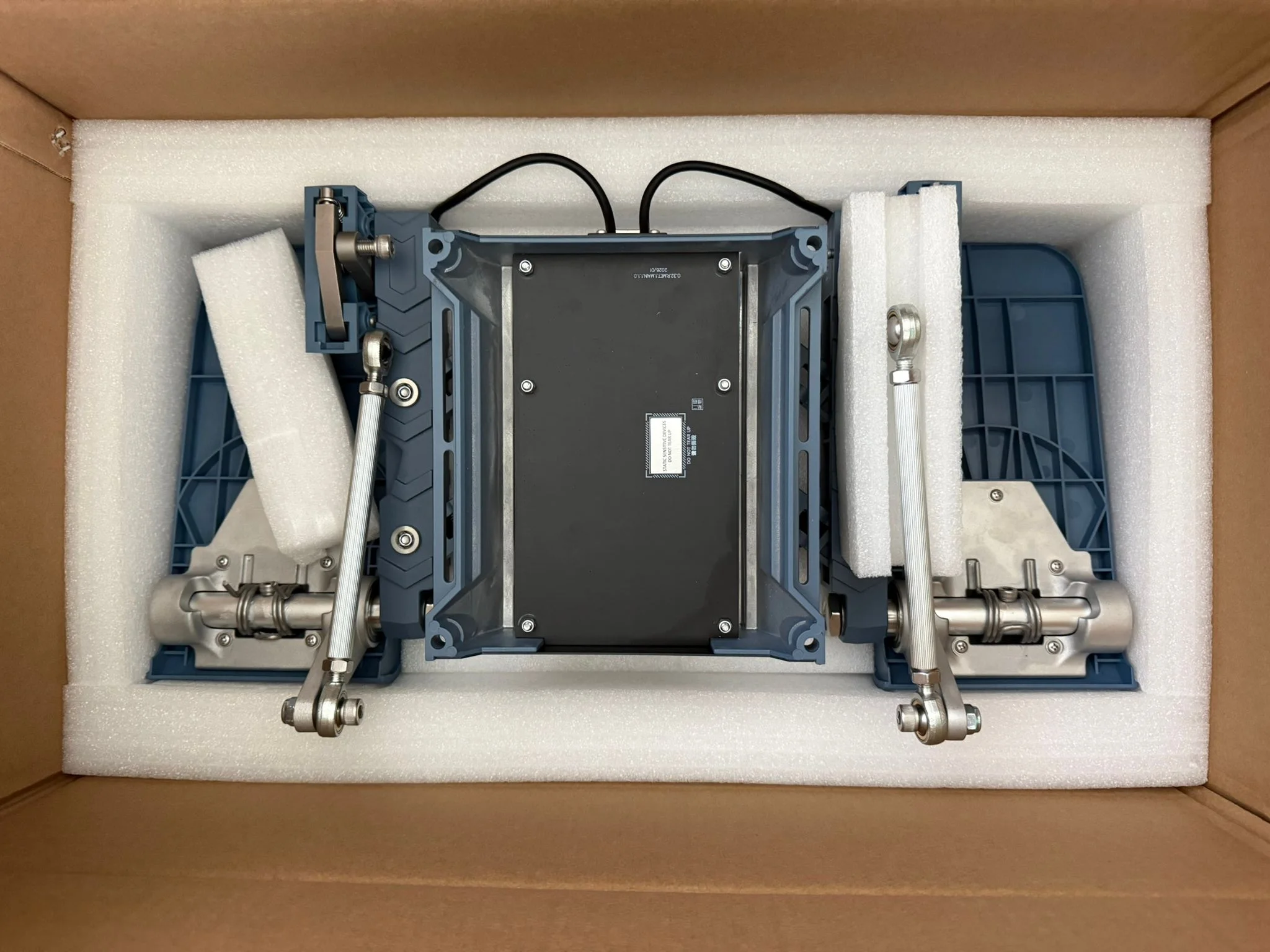
The package is heavy – a good sign of stability. WinCTRL usually forgoes fancy, glossy packaging, but invests in excellent foam protection.
- Contents:
- The main unit (base) is made of die-cast aluminum.
- Two large pedal pads (footpads).
- An extra spring
- USB-C cable and mounting tool (Allen key).
- Damper kit.
First impression: “Industrial grade.” Nothing rattles here. The pedals feel cold and solid, a far cry from the plasticky feel of the competition in the mid-price range. The only exception is the footrests, which are made of hard plastic. This makes no difference in practice, but is somewhat disappointing at first glance. I don’t even know what material the footrests are made of in the original aircraft; perhaps one of you could add that information in the comments.
2. Assembly & Hardware Setup
Assembly is intuitive, but requires a bit of strength due to the weight. You should consult the manual, which is not included in the box but available on the WinCTRL website; it explains everything, including assembly drawings. Here’s the link: https://tinyl.co/4NXI


- Pedal surfaces: first, the springs should be screwed from the packaging position into the correct position, then the two arms should be tightened to the unit using the included screws.
- Damper installation: If you are using the hydraulic damper, it is attached to the rear. It is crucial for the “sluggish” feel of a heavy machine.
- Mounting: The entire unit is then screwed onto the supplied base plate with four screws. This plate has rubber feet, but it slips on smooth floors during hard braking (toe braking).
- Tip: Use the pre-drilled holes to screw it onto a wooden board or directly onto your sim rig.


3. Setup & Software
WinCTRL uses SimAppPro software. This is both a blessing and a curse: the software is feature-rich, but sometimes seems a bit overloaded.
- Calibration: After connecting, SimAppPro immediately recognizes the device. Perform axis calibration for the rudder movement and both toe brakes.
- Customization: Here you can adjust dead zones and curves, although I recommend leaving these on “Linear” in MSFS or X-Plane 12, as the mechanics are already very precise. Actually, you don’t need to do anything, as everything is correctly configured from the factory.
- Firmware: Check immediately after unpacking whether an update is available – I’ve heard that WinCTRL regularly optimizes sensor readings.

4. Performance in flight
What distinguishes the Orion 32 from cheaper pedals is its precision around the center position .
- Rudder axis: Thanks to the Hall effect sensors, there is no “jittering.” The movement is buttery smooth. Once the damper is installed, corrections during crosswind approaches feel extremely controlled.
- Toe Brakes: The brake resistance is firm. You really feel like you’re pressing a mechanical brake, rather than just compressing a spring.
- Ergonomics: The spacing of the pedals is more like a real cockpit than narrow gaming pedals.
Orion 32 vs. Thrustmaster TPR: Upgrading from the TPR is really only worthwhile for absolute Airbus purists. The ergonomics are noticeably different, however: With the TPR, you operate the brake more from your ankle (pivot point at the bottom), while with the Orion 32, the pressure point is located in the middle of the pedals – typical of airliners. But be warned: The brakes are extremely stiff. You need significantly more leg strength than with the TPR, and I searched in vain for an option to reduce this considerable resistance.
The damping: The hydraulic damper prevents the rudder axis from snapping back into the center position when released. Instead of an abrupt “clang,” the pedals glide back to the neutral position in a controlled and smooth manner. While it’s certainly possible to fly without a damper, it significantly enhances the realism and quality of the haptic feedback.
Maximum versatility: Whether flight sim or racing – the Orion 32 is a true all-rounder. Without the main spring, the pedals offer the necessary resistance-free movement for helicopter pilots , although the damper is required in this case. Thanks to the clever mechanism (pull the crossbar and turn it 90°), they can also be converted for racing simulations in no time .
Announced pricing models for shipping from Europe:
- Premium bundle: €325.02 (incl. hydraulic damper)
- Standard version: €286.61 (without damper)
Verdict: The WinWing Orion 32 is a workhorse for the home cockpit. It bridges the gap between gaming hardware and professional training equipment. Especially for users who switch between airliners, helicopters, and racing models and have outgrown Logitech/Saitek pedals, there is currently hardly a more flexible solution on the market. Anyone with the leg strength for the stiff brakes will get a device that will likely be the last pair of pedals they ever need to buy.
| Pro | Contra |
| Excellent material quality: Solid all-metal construction for maximum durability. | High effort required for braking: The toe brakes are very stiff and cannot be adjusted to be softer. |
| Outstanding versatility: Quick conversion for helicopter (springless) and racing simulations (90° rotation). | Space requirements & weight: The pedals are large and heavy; they also tend to slip, so counter-pressure (e.g., a wall) is recommended. |
| Realistic damping behavior: The optional damper prevents harsh rebound and provides a “smooth” feel. | Software learning curve: While the SimAppPro software offers many features, it initially seems somewhat overloaded. |
| Precise sensor technology: High-quality Hall effect sensors guarantee wear-free and vibration-free control. | Ergonomics check: The central pivot point of the brakes is ideal for Airbus fans, but takes some getting used to for jet pilots. |
| Fair price-performance ratio: At approximately €325 (including damper), it is significantly cheaper than many boutique solutions. |
The manufacturer’s product page is here: https://eu.winctrl.com/view/goods-details.html?id=546


